If you have done the Death Knight starting zone questline or have interacted with the Knights of the Ebon Blade, you have likely heard one of those reanimated warriors say "suffer well" after you finish talking with them. This always seemed a bit odd to me, but I just chalked it up to their deathly nature. However, a chapter from Arthur Schopenhauer's Studies in Pessimism entitled "On the Sufferings of the World" gave me a new perspective on this salutation, perspective I would like to share here.
Before I talk about that, let me summarize the relevant portions of On the Sufferings of the World. (You can read the whole thing here if you are interested. If you are familiar with it, skip this paragraph and the next two.) On the Sufferings of the World begins by acknowledging that everyone, by virtue of their existence, suffers. Our friends and family die, time is slowly wearing away on us, and tragedy enjoys visiting us on a regular basis. Schopenhauer also contends that happiness is really the absence of suffering, for happiness only serves to distract us from the miseries of the world. Thus the default mode of our life is suffering, so life is suffering. As such, suffering must have a purpose, for if suffering has no purpose, than life has no purpose. After all, if there is no point to suffering, then why go on living if we are doomed to suffer?
Schopenhauer discovers a few purposes for suffering in this chapter. One is that it gives our lives meaning--purpose, if you will. Most of what we do is motivated by the desire to avoid suffering. We work so we can make money so we can eat so we don't feel hungry. We socialize so we can have friends so we don't feel alone. We play World of Warcraft so we don't feel bored. "..if all wishes were fulfilled as soon as they arose, how would men occupy their lives? what would they do with their time? If the world were a paradise of luxury and ease, a land flowing with milk and honey, where every Jack obtained his Jill at once and without any difficulty, men would either die of boredom or hang themselves..." In other words, eliminate suffering, and our lives have no purpose, causing us to become depressed from the lack of things to do. That may sound absurd to you, but it turns out that suicide rates increase as you move up social brackets, so Schopenhauer is right when he says that, if there were no suffering, we would die of boredom or hang ourselves.
Schopenhauer then goes on to talk about how our powers of reflection and and expectation cause us to suffer even more, but let me skip to the important part, the part you'll want to pay attention to. Towards the end of On the Sufferings of the World, Schopenhauer says that the best perspective to see this world from is to see it as a prison of pain, a penitentiary of misery, a jailhouse of suffering. Why, you may wonder? Because then we can adjust our view of the world accordingly and brace ourselves for the suffering we will inevitably face. If we see life as full of misery, then when tragedy does strike our lives, it will not come as some great surprise, and it shouldn't, for we all know that bad things happen. More importantly, when we recognize that we are suffering, and that other people are suffering, it's much easier to be empathetic towards others. After all, when our we perceive our lives as good, it's difficult to be empathetic towards others because we don't want to get bogged down in their misery. And, of course, if others' lives seem good, we have no reason to be empathetic towards them, for they don't need our empathy. However, if we see our lives as bad and others' lives as bad, "...it reminds us of that which is after all the most necessary thing in life—the tolerance, patience, regard, and love of neighbor, of which everyone stands in need, and which, therefore, every man owes to his fellow."
So, what does that have to do with Death Knights? By saying "Suffer well" to people who talk to them, Death Knights (from here on in, I am referring to Death Knight NPCs, not Death Knight players) acknowledge that suffering is a part of life; they don't try to sugar coat it. This is especially true in WoW, where your character gets attacked by wild beasts, monsters, and agents of the scourge on a daily basis, or even other players if you PvP. Suffering is an intrinsic part of your character's life; in fact, it probably defines your character's life. Death Knights' saying "suffer well" acknowledges that suffering and the fact that without it, your character's life would likely be meaningless. "Suffer well" is simply a more appropriate greeting than something like "Have a good day," for such a greeting ignores the suffering that is a necessary part of life.
What can we take away from these former agents of the Lich King and their Schopenhauer-inspired salutation? For starters, we can realize that everyone around us is fighting their own personal battles, that everyone around us suffers, and thus when we suffer, we won't feel so alone. We can recognize that suffering motivates most of what we do and thus have some appreciation for it; we can see it as the unfortunate necessity that it is, rather than proof that this is a cold, uncaring universe (although that is a completely different topic). When suffering seems pointless, like when someone is slowly dying of a terminal disease or when you lose a family member, we can recognize that suffering is a vector for empathy, an experiences that motivates us to connect with others. And so, I say to you, my readers, suffer well.
If you found this post depressing, let me leave you with one more quote from On the Sufferings of the World: "I shall be told, I suppose, that my philosophy is comfortless—because I speak the truth; and people prefer to be assured that everything the Lord has made is good. Go to the priests, then, and leave philosophers in peace! At any rate, do not ask us to accommodate our doctrines to the lessons you have been taught. That is what those rascals of sham philosophers will do for you. Ask them for any doctrine you please, and you will get it."
Showing posts with label death knight. Show all posts
Showing posts with label death knight. Show all posts
Friday, February 26, 2010

Friday, September 25, 2009
Should Blizzard buff/nerf classes based on popularity?
This question has been on my mind ever since I read a WoW.com post that said that because druid tanks were the least popular kind of tank, Blizzard was hesitant to nerf them. This was part of a longer article about the relative popularity of certain tank classes, which showed that warriors were the most popular tanks by far, with druids being the least popular. The article speculated that the reason for this was that warriors have always been viable as tanks, but paladins and druids only became popular as tanks with the advent of Burning Crusade. Even then, paladins were arguably better tanks than druids, and only recently have druids become truly viable as tanks. Death Knights have been popular ever since they were added to the game, which explains why they had no problem carving out a part of the tanking community for themselves.
But I digress. The fact that Blizzard was hesitant to make any changes to an unpopular class got me thinking: should Blizzard buff or nerf classes based on how popular they are? Although the popularity of a class can be viewed as an indicator of its relative strength compared to other classes, such a comparison is misleading. After all, for the longest time, hunters were the most popular class in the game due only to the fact that they were a good class for newbies. Death knights are now by far the most popular class, but I would argue that this is due to their newness, and not their relative strength compared to other classes. The popularity of a class can be based on many things, meaning you cant take it to be an indicator of that class's relative strength.
This means that Blizzard can't use class popularity as a guide on how the classes should be buffed and nerfed, but does that mean that it shouldn't factor in at all? In an ideal world (of warcraft), it wouldn't. The classes would all be able to stand out on their own merits because they would all be fun to play, and thus you would have players dedicated to their class who would play it come hell or high water, even if their class were nerfed into the ground. Thus, if every class is fun to play, then Blizzard doesn't need to factor their popularity in how they buff/nerf them, since that class's devotees would continue to play as that class.
This begs the question, though; are the classes fun to play? Having limited experience with the various class, I can't truly say. I suppose the fact that, aside form death knights and paladins, the other classes have more or less equal representation at level 80 could be a sign that people enjoy playing all of them. Each class and each class's specs are unique in their own way, meaning there is something about each the ten classes and 30 specs in the game that appeals to some kind of player. That said, there are certainly specs that are more limited than others in terms of how they can perform their role (holy paladins, balance druids) and perhaps they could be fleshed out a little bit more, but people still play them, so they must be enjoyable in some way.
But I digress. The fact that Blizzard was hesitant to make any changes to an unpopular class got me thinking: should Blizzard buff or nerf classes based on how popular they are? Although the popularity of a class can be viewed as an indicator of its relative strength compared to other classes, such a comparison is misleading. After all, for the longest time, hunters were the most popular class in the game due only to the fact that they were a good class for newbies. Death knights are now by far the most popular class, but I would argue that this is due to their newness, and not their relative strength compared to other classes. The popularity of a class can be based on many things, meaning you cant take it to be an indicator of that class's relative strength.
This means that Blizzard can't use class popularity as a guide on how the classes should be buffed and nerfed, but does that mean that it shouldn't factor in at all? In an ideal world (of warcraft), it wouldn't. The classes would all be able to stand out on their own merits because they would all be fun to play, and thus you would have players dedicated to their class who would play it come hell or high water, even if their class were nerfed into the ground. Thus, if every class is fun to play, then Blizzard doesn't need to factor their popularity in how they buff/nerf them, since that class's devotees would continue to play as that class.
This begs the question, though; are the classes fun to play? Having limited experience with the various class, I can't truly say. I suppose the fact that, aside form death knights and paladins, the other classes have more or less equal representation at level 80 could be a sign that people enjoy playing all of them. Each class and each class's specs are unique in their own way, meaning there is something about each the ten classes and 30 specs in the game that appeals to some kind of player. That said, there are certainly specs that are more limited than others in terms of how they can perform their role (holy paladins, balance druids) and perhaps they could be fleshed out a little bit more, but people still play them, so they must be enjoyable in some way.
Friday, September 11, 2009
What purpose should talents serve?
With the upcoming mastery effects, which talent tree you invest in is, more than ever, going to be the indicator of what role you are spec'ing for. Players will be forced to spec one way to perform a certain role, although this might not apply as much for the pure-DPS classes. This is not a break from the norm. For almost as long as WoW has existed, each talent tree was associated with a specific role, with the exception of feral combat and the earlier incarnations of discipline. (Tanking/DPS and DPS/healing, respectively) Each spec played differently, and even though you may have pined for protection to feel more like fury, or for restoration to feel more like elemental combat, there wasn't much you could do about it.
Death Knights changed all that. The three death knight specs are all viable as tank, DPS, and PvP specs, though some more so than others. The thing that set DK's apart was that, rather than use their talents to pick their role, they chose which presence they would use (similar to the warrior's stances), and the bonuses of each presence were what differentiated a tank from a DPS. This was a pretty big departure from the other classes, for while the death knight specs certainly had talents that hinted at the intended roles of each tree, each spec catered more to a specific play-style than a specific role. Blood is centered around grinding and self-healing, frost is centered around snares and defensive talents, and unholy is centered around diseases and your ghoul pet. Because each tree contains both offensive and defensive talents, it is not too rare to see frost DPS or blood tanks. In the end, the process picking which talents to take as a DK is all about play-style.
That got me thinking: is it possible for the other classes to play that way as well? What if other classes simply used their talent trees as a way of adjusting their play-style while using something like presences to decide which role they would play? It would certainly require a general overhaul of the talent system, something I doubt Blizzard is ready to do, but the possibility is still there. Some classes already have the abilities they need to make such a thing possible. Druids have their shapeshifting forms and warriors have their stances. The other classes also have abilities that could be expanded upon to serve the same purpose. Priests have Shadowform, and I imagine adding some sort of Holyform couldn't be too difficult. Paladins have Righteous Fury, which could evolve to give more tanking bonuses, and Blizzard could add a healing and a DPS equivalent; perhaps Righteous Wisdom and Righteous Vengeance. Shamans are a bit tougher to figure out. They currently have no self-buffs that give them a bonus to their DPS or healing. Perhaps their weapon buffs could be expanded to fill the purpose. Windfury would be the melee DPS one, with Flametounge, Frostbrand, and Earthliving being the spell DPS, PvP, and healing, respectively.
You may notice I did not include Hunters, Mages, Rogues, or Warlocks in my ruminations. What you need to keep in mind is that the purpose of the talent overhaul that I am considering is that it would make a player's role (tank, DPS, healing) independent of their talents. Since the four aforementioned classes can only DPS, such an overhaul would only have a minor effect on them.
So, suppose we were able to tie each of the multiple-role classes's roles to a self-buff. What purpose would the talent trees serve, then? Again, I look to the DK talents as my model. Because the DK talents are based around the kind of play-style that accompanies their implied role, the other talent trees and class abilities could be changes in a similar way. Here are my ideas for the druid talent trees.
Druids would be able to learn all of their forms, including Moonkin and Tree of Life Form, from a trainer. Because Balance has long been considered the PvP tree, it would contain a lot of PvP talents, including the ones in other trees, like Infected Wounds. Because PvP is all about controlling your opponent, that would be what this tree is concerned with. As such, a Balance tank would perhaps focus more on kiting his target than simply standing still, while still causing a lot of threat from far away. Feral combat is currently associated with all of the druid's melee combat, and as such, ferals currently end up take more damage than the other specs. Thus, this tree would become more of an all-around defensive tree. It could thus get talents like Improved Barkskin. Resto is currently associate with healing, but this could be expanded to include any sort of survival, making it more applicable to tanking and PvP. Whereas a feral tank would be focused on taking less damage, a resto tank would be focused on healing his own damage to assist the healer.
I know I usually save posts containing ideas for Monday, but I just wanted to include that example and the examples in the third paragraph to show that a change like this feasible, even if it isn't probable. Still, is a change like this even necessary? Now that we know what kind of changes we are talking about, I can start answering that question.
The main issue that determines whether such a talent overhaul is called for is whether the changes is would bring are necessary. There are two changes that I can see happening as a result of this overhaul:
1. Tanks and healers would be able to do moderate DPS without switching specs. Inversely, your DPS could switch to being a tank or a healer in an emergency or when the first requires it.
2. Picking which talent tree you choose to invest in would be less about what role you wish to perform and more about which nuances of the class your play-style emphasizes.
Let's consider the first one. I know there are raid fights where it helps to have multiple tanks sometimes, while other times you only need one. The same can be said of healers, in that some phases of a fight require more than others. On the surface, a change that lets you change your raid line-up on the fly seems like a good thing. However, you need to consider the pure DPS'ers: the hunters, mages, rogues, and warlocks. These guys are all DPS, no matter what their spec, so they are already experiencing the reality that I am talking about. Thing is, they can't become a tank or a healer in an emergency, so any change to make the hybrid classes more valuable than the pure DPS classes could see their representation in raids drop. Blizzard could prevent this by giving them better raid utility than the hybrid DPS'ers. As I found in my post on what classes bring what buffs and debuffs to raids, the pure DPS classes, especially mages and rogues, are pretty limited in terms of what buffs they can bring. In the olden days, this was offset by the fact that they brought the highest DPS to raids, but now that every class is on more or less equal footing when it comes to DPS, that excuse no longer cuts it. If Blizzard were to give the pure DPS classes more raid buffs, they could motivate raid leaders to bring pure DPS'ers without needing nerfing the buffs that hybrid DPS'ers already bring to raids. Still such a change probably isn't necessary, since you can only have so many players acting as tanks and healers before you loose DPS, so the roles of the pure-DPS classes weren't really in jeopardy. Thus, the first effect of this talent overhaul would be a positive one. Necessary? Well, it would certainly help.
The other effect of this change would be that choosing talents would be more about play-style than utility. Every class's spec would thus play differently, yes still be able to fulfill the same roles, allowing there to in effect be thirty classes in the game. I know that's a bit of hyperbole, but I can tell you that playing a blood death knight is quite different from playing an unholy one, despite the fact that the two can both be DPS'ers. The same can be said of discipline and holy priests; both are healers, but both play and feel quite different. The same can be said of the four pure-DPS classes and how their specs play. They fulfill the same role in raids and they do them (arguably) equally well. In the end, it's all about player choice. That's really what a change like this would be about; letting players who play a Druid, Paladin, Priest, Shaman, or Warrior choose how they wish to approach their role. I see no downsides to this.
So, should Blizzard do it? Should Blizzard redo the Druid, Paladin, Priest, Shaman, and Warrior talent trees to make them more like the Death Knight trees? As much as I hate to say it, probably not. Think about it: it took Blizzard twelve patches, an expansion pack, four more patches, and another expansion pack to get class balance right. They have said that they weren't very concerned with perfect class balance in vanilla WoW, but still, that means it took them two expansion packs to get it right. Could you imagine if they were to start over? I don't know about you, but I don't want to wait until after Cataclysm and what ever is next (Emerald Dream?) for class balance to be good again.
Still, even if Blizzard were to somehow get it right the first time, a system like this would make class balance even more difficult than it is now. Imagine if a holy paladin could be a DPS'er, a tank, or a healer. That's three times as many sub-classes (which are basically what the talent trees are) to balance against the rest. I won't do the math to see how many more sub-classes that would mean, but trying to balance that many specs for that many roles would be a pain in the neck for Blizzard, especially considering how much people already complain about class balance. As much as I would love to see a change like this, I don't see it happening.
So, going back to the original question, though it would be awesome if talents let you augment the nuances of your class, I think it is better for Blizzard to stay with the current systems. I know it's not good form for a writer to argue against an idea that he himself came up with, so I apologize for that. Here, have some cute to make up for it. Here's some more for good measure.
Death Knights changed all that. The three death knight specs are all viable as tank, DPS, and PvP specs, though some more so than others. The thing that set DK's apart was that, rather than use their talents to pick their role, they chose which presence they would use (similar to the warrior's stances), and the bonuses of each presence were what differentiated a tank from a DPS. This was a pretty big departure from the other classes, for while the death knight specs certainly had talents that hinted at the intended roles of each tree, each spec catered more to a specific play-style than a specific role. Blood is centered around grinding and self-healing, frost is centered around snares and defensive talents, and unholy is centered around diseases and your ghoul pet. Because each tree contains both offensive and defensive talents, it is not too rare to see frost DPS or blood tanks. In the end, the process picking which talents to take as a DK is all about play-style.
That got me thinking: is it possible for the other classes to play that way as well? What if other classes simply used their talent trees as a way of adjusting their play-style while using something like presences to decide which role they would play? It would certainly require a general overhaul of the talent system, something I doubt Blizzard is ready to do, but the possibility is still there. Some classes already have the abilities they need to make such a thing possible. Druids have their shapeshifting forms and warriors have their stances. The other classes also have abilities that could be expanded upon to serve the same purpose. Priests have Shadowform, and I imagine adding some sort of Holyform couldn't be too difficult. Paladins have Righteous Fury, which could evolve to give more tanking bonuses, and Blizzard could add a healing and a DPS equivalent; perhaps Righteous Wisdom and Righteous Vengeance. Shamans are a bit tougher to figure out. They currently have no self-buffs that give them a bonus to their DPS or healing. Perhaps their weapon buffs could be expanded to fill the purpose. Windfury would be the melee DPS one, with Flametounge, Frostbrand, and Earthliving being the spell DPS, PvP, and healing, respectively.
You may notice I did not include Hunters, Mages, Rogues, or Warlocks in my ruminations. What you need to keep in mind is that the purpose of the talent overhaul that I am considering is that it would make a player's role (tank, DPS, healing) independent of their talents. Since the four aforementioned classes can only DPS, such an overhaul would only have a minor effect on them.
So, suppose we were able to tie each of the multiple-role classes's roles to a self-buff. What purpose would the talent trees serve, then? Again, I look to the DK talents as my model. Because the DK talents are based around the kind of play-style that accompanies their implied role, the other talent trees and class abilities could be changes in a similar way. Here are my ideas for the druid talent trees.
Druids would be able to learn all of their forms, including Moonkin and Tree of Life Form, from a trainer. Because Balance has long been considered the PvP tree, it would contain a lot of PvP talents, including the ones in other trees, like Infected Wounds. Because PvP is all about controlling your opponent, that would be what this tree is concerned with. As such, a Balance tank would perhaps focus more on kiting his target than simply standing still, while still causing a lot of threat from far away. Feral combat is currently associated with all of the druid's melee combat, and as such, ferals currently end up take more damage than the other specs. Thus, this tree would become more of an all-around defensive tree. It could thus get talents like Improved Barkskin. Resto is currently associate with healing, but this could be expanded to include any sort of survival, making it more applicable to tanking and PvP. Whereas a feral tank would be focused on taking less damage, a resto tank would be focused on healing his own damage to assist the healer.
I know I usually save posts containing ideas for Monday, but I just wanted to include that example and the examples in the third paragraph to show that a change like this feasible, even if it isn't probable. Still, is a change like this even necessary? Now that we know what kind of changes we are talking about, I can start answering that question.
The main issue that determines whether such a talent overhaul is called for is whether the changes is would bring are necessary. There are two changes that I can see happening as a result of this overhaul:
1. Tanks and healers would be able to do moderate DPS without switching specs. Inversely, your DPS could switch to being a tank or a healer in an emergency or when the first requires it.
2. Picking which talent tree you choose to invest in would be less about what role you wish to perform and more about which nuances of the class your play-style emphasizes.
Let's consider the first one. I know there are raid fights where it helps to have multiple tanks sometimes, while other times you only need one. The same can be said of healers, in that some phases of a fight require more than others. On the surface, a change that lets you change your raid line-up on the fly seems like a good thing. However, you need to consider the pure DPS'ers: the hunters, mages, rogues, and warlocks. These guys are all DPS, no matter what their spec, so they are already experiencing the reality that I am talking about. Thing is, they can't become a tank or a healer in an emergency, so any change to make the hybrid classes more valuable than the pure DPS classes could see their representation in raids drop. Blizzard could prevent this by giving them better raid utility than the hybrid DPS'ers. As I found in my post on what classes bring what buffs and debuffs to raids, the pure DPS classes, especially mages and rogues, are pretty limited in terms of what buffs they can bring. In the olden days, this was offset by the fact that they brought the highest DPS to raids, but now that every class is on more or less equal footing when it comes to DPS, that excuse no longer cuts it. If Blizzard were to give the pure DPS classes more raid buffs, they could motivate raid leaders to bring pure DPS'ers without needing nerfing the buffs that hybrid DPS'ers already bring to raids. Still such a change probably isn't necessary, since you can only have so many players acting as tanks and healers before you loose DPS, so the roles of the pure-DPS classes weren't really in jeopardy. Thus, the first effect of this talent overhaul would be a positive one. Necessary? Well, it would certainly help.
The other effect of this change would be that choosing talents would be more about play-style than utility. Every class's spec would thus play differently, yes still be able to fulfill the same roles, allowing there to in effect be thirty classes in the game. I know that's a bit of hyperbole, but I can tell you that playing a blood death knight is quite different from playing an unholy one, despite the fact that the two can both be DPS'ers. The same can be said of discipline and holy priests; both are healers, but both play and feel quite different. The same can be said of the four pure-DPS classes and how their specs play. They fulfill the same role in raids and they do them (arguably) equally well. In the end, it's all about player choice. That's really what a change like this would be about; letting players who play a Druid, Paladin, Priest, Shaman, or Warrior choose how they wish to approach their role. I see no downsides to this.
So, should Blizzard do it? Should Blizzard redo the Druid, Paladin, Priest, Shaman, and Warrior talent trees to make them more like the Death Knight trees? As much as I hate to say it, probably not. Think about it: it took Blizzard twelve patches, an expansion pack, four more patches, and another expansion pack to get class balance right. They have said that they weren't very concerned with perfect class balance in vanilla WoW, but still, that means it took them two expansion packs to get it right. Could you imagine if they were to start over? I don't know about you, but I don't want to wait until after Cataclysm and what ever is next (Emerald Dream?) for class balance to be good again.
Still, even if Blizzard were to somehow get it right the first time, a system like this would make class balance even more difficult than it is now. Imagine if a holy paladin could be a DPS'er, a tank, or a healer. That's three times as many sub-classes (which are basically what the talent trees are) to balance against the rest. I won't do the math to see how many more sub-classes that would mean, but trying to balance that many specs for that many roles would be a pain in the neck for Blizzard, especially considering how much people already complain about class balance. As much as I would love to see a change like this, I don't see it happening.
So, going back to the original question, though it would be awesome if talents let you augment the nuances of your class, I think it is better for Blizzard to stay with the current systems. I know it's not good form for a writer to argue against an idea that he himself came up with, so I apologize for that. Here, have some cute to make up for it. Here's some more for good measure.
Friday, August 21, 2009
Why the leveling process doesn't help a player learn their class
One of the most frequent arguments I see used in debates on whether or not to let players with high-level characters start new characters at a high level (say, 55) is that those 55 levels help a player learn their class. Although there are many reasons to go through the whole leveling process (as I mentioned here) I do not see the "it helps you learn your class" argument as a legitimate reason to force players to go through the leveling process after they have done it once. In other words, I do not think that the leveling process helps a player learn their class.
First of all, when many people refer to "learning one's class," they mean learning one's class for the purposes of raiding. In PvP situations, most people don't mind as much if they fight with someone who doesn't know their class, and most people are quite happy to fight against someone who doesn't know their class. In raiding, however, if someone doesn't know how to play their class, then everyone suffers. Thus, when I say "learning one's class," will from now on be referring to "being prepared for raids." This also applies for 5-man instances, which are meant to be a stepping stone between solo-ing and raids.
Now, the first thing one needs to know when preparing for raids is where he fits in. I am, of course, referring to the three key roles: tank, DPS, and healer. It is my opinion that the leveling process does not adequately prepare players for any of these roles. For example, when it comes to tanking, one concept frequently lost on new tanks is that tanks always need to hold the attention of the enemies, with rare exception. Let's imagine a warrior solo-ing his way to 80. Since has has only fought for himself, he has no concept of keeping a monster attacking him, even if he is low on health. He may be glad to see that monster run away once it gets low on health. That gives him an opportunity to bandage up or loot another guy he killed. If he has high health, then he will probably be just as glad to see that runner grab an extra guy; it means that the monster and the loot it drops will come to him, rather than him needing to run to it. Of course, everyone who has ever done an instance knows that this kind of attitude towards runners is a guaranteed way to cause a wipe. More adds means more damage means healer heals more means healer runs out of mana means everyone dies.
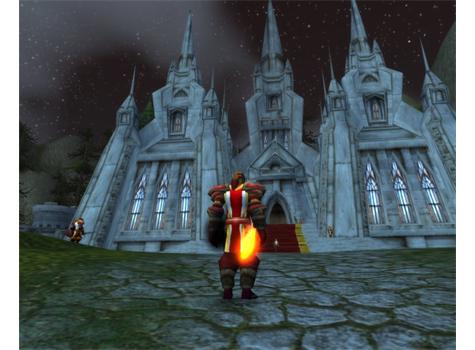 Now that he's gone, we can focus on the other one, right guys? ...guys?
Now let's say our little lonely warrior is out fighting a gnoll and another one runs past him to attack someone else. He is the same level as the gnolls, and his gear isn't the greatest (he is leveling, after all, and will soon replace it), and thus he can't take on two at once. Thus he lets it attack the other player, and if it comes back to attack him, he runs away. Put that warrior in an instance, and you have a tank who lets adds attack the mage and actually runs for the instance entrance when it all goes wrong, both of which are bad to do. (Note: I did both of these things when I first tanked Deadmines, so I am not making these things up.)
As for DPS, while leveling, more damage=faster kill=better chance of survival. While raiding, more damage=likely out-threat-ing the tank=death, or potential wipe. The leveling process teaches DPS nothing of threat, one of the most basic concepts necessary for a DPS to know for raids. Leveling creates a mindset that more damage is always good, and that moderation of damage is never necessary. Obviously, when raiding, the opposites of both facts are true, yet it seems that many a DPS that I have PUG'ed with have no concept of threat or damage moderation.
Healing is also a difficult concept for solo-ers to grasp. Put a priest who has always had to fend for himself in a group and he'll probably at the very least keep a shadow word: pain up on the boss. Leveling also requires strategies for survival that are not viable in groups. A solo-ing priest will use power word: shield a lot to protect them from damage and allow them to cast spells unimpeded. However, unless a priest is spec'ed deep Discipline and the tank is a high enough level (read: 80) that he doesn't need to depend on taking damage to generate rage/mana (if a paladin), then the shield will be a liability. Solo-ing also frowns upon overhealing, as it wastes mana, which means more downtime. In a group, overhealing is certainly not the ideal, but it's better than a dead tank.
Most importantly---and this can be applied to all players regardless of the roll they play in raids---solo-ing teaches a player to be self-reliant, and the habits of self-reliant players are often detrimental to the success of a raid, where everyone needs to work together. Now, when I refer to self-reliant behavior, I'm not talking about a shaman DPS healing damage he took from an AoE effect if the healer is busy healing the tank. I'm talking about a priest using psychic scream when he is attacked, a druid tank shifting out of bear form to heal himself, a mage using ice armor for its defensive capabilities rather than mage armor for more mana or molten armor for more DPS, a mana-using DPS going OOM because he was using his highest-damage abilities rather than his most mana-efficient ones, a frost mage going into an instance spec'ed for survival and not for damage and putting out sub-par DPS as a result, a hunter using distracting shot to "save" a tank because he does it when his pet is low on health and he can usually take the damage, or an elemental shaman using stoneskin totem in a raid rather than strength of earth totem because he has no use for strength or agility. All of these are mistakes I have seen players make, even in level 80 instances, where players should know better.
 Just like in real life, methods you use to protect yourself in WoW are often counter-productive to the success of the group, impeding others from accomplish their goals. Oh yeah, I just combined WoW, philosophy, and political commentary with one picture and one caption. I'd like my medal now.
"But," you may say, "we all had to go through the leveling process, so why don't we all suck?" First of all, Dr. Dennis Leary would disagree with your assumption. Second of all, players learn the above-mentioned concepts not by leveling, but by doing low-level instances and/or group quests. That's how I learned about tanking, and it's how anyone who wants to learn the basics of grouping gets started. However, anyone who has already reached level 80 and is leveling a second character probably isn't going to want to run a low-level instance, so they won't get any experience with their new class in groups. And since they probably already understand the basics, why would they need to learn anything anyways?
"But," you say, "if someone has been a tank all the time they've been playing WoW, how can they learn another role?" I recently had this experience. For as long as I can remember, I was a tank on my druid. With the advent of dual-specs, I could finally become a healer, a role which I had always wanted to try out but never did for fear of losing my solo-viability. Having never healed an instance before, I read some online guides to druid healing, did the math to figure out my most mana efficient heals, familiarized myself with my new keyboard layout, and started in an instance I was already familiar with---Violet Hold. Not only did I heal really well, but I even got complimented on my healing, and I now heal raids in my guild frequently. Point is, though not all roles are created alike, learning a new role and learning it well has nothing to do with leveling.
"But," you should be saying now, "what about learning the nuances of your class? Put a level 50 shaman in the hands of someone who isn't familiar with the class and they will be overwhelmed." First of all, anyone who is lucky enough to receive a level 50 shaman should get on their knees and thank whichever god, gods, deity, or deities they worship for what they have received (unless they already have one, of course). I will admit, it would probably be overwhelming to learn a class from scratch at level 50. I think that if a "start a new character at 55" system where ever implemented, it would need to be like the Death Knight starting quests. It would grant players their talent points and abilities slowly, allowing players to become acclimated to their class at a comfortable pace. These quest-lines could also be class specific, allowing players to learn the intricacies of their class better. With the news the Cataclysm may completely change Azeroth, such a system may be possible. Imagine starting a new soldier of Stormwind/Orgimmar in a war-torn world where only a few fragments of the old conflicts remain. Since the various leaders need more troops fast, they could use these new recruits to clean up the mess left in Azeroth's old zones while using the experience to help them prepare for the coming battles. I think that quests like that would make for a good story. I'll post next Monday on ideas I have for how such a system could be implemented. (Edit: I never did this, for lack of ideas, and I apologize.) That is, unless Blizzard comes out and says the leaked Cataclysm details were hoaxed and MMO Champion was wrong.
 Would they lie to us? Well, maybe... You can't really blame them if Blizzard was using the alleged leak as a foiler to test the waters with player's reaction to radical changes.
Coming back to the main point, leveling does a lot of things, but the only thing it does really well is prevent a player from getting to the new content with a new character in a timely manor. Blizzard has already said that they think end-game is where it's at, so why they won't let players get on the fast track there is beyond me.
First of all, when many people refer to "learning one's class," they mean learning one's class for the purposes of raiding. In PvP situations, most people don't mind as much if they fight with someone who doesn't know their class, and most people are quite happy to fight against someone who doesn't know their class. In raiding, however, if someone doesn't know how to play their class, then everyone suffers. Thus, when I say "learning one's class," will from now on be referring to "being prepared for raids." This also applies for 5-man instances, which are meant to be a stepping stone between solo-ing and raids.
Now, the first thing one needs to know when preparing for raids is where he fits in. I am, of course, referring to the three key roles: tank, DPS, and healer. It is my opinion that the leveling process does not adequately prepare players for any of these roles. For example, when it comes to tanking, one concept frequently lost on new tanks is that tanks always need to hold the attention of the enemies, with rare exception. Let's imagine a warrior solo-ing his way to 80. Since has has only fought for himself, he has no concept of keeping a monster attacking him, even if he is low on health. He may be glad to see that monster run away once it gets low on health. That gives him an opportunity to bandage up or loot another guy he killed. If he has high health, then he will probably be just as glad to see that runner grab an extra guy; it means that the monster and the loot it drops will come to him, rather than him needing to run to it. Of course, everyone who has ever done an instance knows that this kind of attitude towards runners is a guaranteed way to cause a wipe. More adds means more damage means healer heals more means healer runs out of mana means everyone dies.
Now that he's gone, we can focus on the other one, right guys? ...guys?Now let's say our little lonely warrior is out fighting a gnoll and another one runs past him to attack someone else. He is the same level as the gnolls, and his gear isn't the greatest (he is leveling, after all, and will soon replace it), and thus he can't take on two at once. Thus he lets it attack the other player, and if it comes back to attack him, he runs away. Put that warrior in an instance, and you have a tank who lets adds attack the mage and actually runs for the instance entrance when it all goes wrong, both of which are bad to do. (Note: I did both of these things when I first tanked Deadmines, so I am not making these things up.)
As for DPS, while leveling, more damage=faster kill=better chance of survival. While raiding, more damage=likely out-threat-ing the tank=death, or potential wipe. The leveling process teaches DPS nothing of threat, one of the most basic concepts necessary for a DPS to know for raids. Leveling creates a mindset that more damage is always good, and that moderation of damage is never necessary. Obviously, when raiding, the opposites of both facts are true, yet it seems that many a DPS that I have PUG'ed with have no concept of threat or damage moderation.
Healing is also a difficult concept for solo-ers to grasp. Put a priest who has always had to fend for himself in a group and he'll probably at the very least keep a shadow word: pain up on the boss. Leveling also requires strategies for survival that are not viable in groups. A solo-ing priest will use power word: shield a lot to protect them from damage and allow them to cast spells unimpeded. However, unless a priest is spec'ed deep Discipline and the tank is a high enough level (read: 80) that he doesn't need to depend on taking damage to generate rage/mana (if a paladin), then the shield will be a liability. Solo-ing also frowns upon overhealing, as it wastes mana, which means more downtime. In a group, overhealing is certainly not the ideal, but it's better than a dead tank.
Most importantly---and this can be applied to all players regardless of the roll they play in raids---solo-ing teaches a player to be self-reliant, and the habits of self-reliant players are often detrimental to the success of a raid, where everyone needs to work together. Now, when I refer to self-reliant behavior, I'm not talking about a shaman DPS healing damage he took from an AoE effect if the healer is busy healing the tank. I'm talking about a priest using psychic scream when he is attacked, a druid tank shifting out of bear form to heal himself, a mage using ice armor for its defensive capabilities rather than mage armor for more mana or molten armor for more DPS, a mana-using DPS going OOM because he was using his highest-damage abilities rather than his most mana-efficient ones, a frost mage going into an instance spec'ed for survival and not for damage and putting out sub-par DPS as a result, a hunter using distracting shot to "save" a tank because he does it when his pet is low on health and he can usually take the damage, or an elemental shaman using stoneskin totem in a raid rather than strength of earth totem because he has no use for strength or agility. All of these are mistakes I have seen players make, even in level 80 instances, where players should know better.
Just like in real life, methods you use to protect yourself in WoW are often counter-productive to the success of the group, impeding others from accomplish their goals. Oh yeah, I just combined WoW, philosophy, and political commentary with one picture and one caption. I'd like my medal now."But," you may say, "we all had to go through the leveling process, so why don't we all suck?" First of all, Dr. Dennis Leary would disagree with your assumption. Second of all, players learn the above-mentioned concepts not by leveling, but by doing low-level instances and/or group quests. That's how I learned about tanking, and it's how anyone who wants to learn the basics of grouping gets started. However, anyone who has already reached level 80 and is leveling a second character probably isn't going to want to run a low-level instance, so they won't get any experience with their new class in groups. And since they probably already understand the basics, why would they need to learn anything anyways?
"But," you say, "if someone has been a tank all the time they've been playing WoW, how can they learn another role?" I recently had this experience. For as long as I can remember, I was a tank on my druid. With the advent of dual-specs, I could finally become a healer, a role which I had always wanted to try out but never did for fear of losing my solo-viability. Having never healed an instance before, I read some online guides to druid healing, did the math to figure out my most mana efficient heals, familiarized myself with my new keyboard layout, and started in an instance I was already familiar with---Violet Hold. Not only did I heal really well, but I even got complimented on my healing, and I now heal raids in my guild frequently. Point is, though not all roles are created alike, learning a new role and learning it well has nothing to do with leveling.
"But," you should be saying now, "what about learning the nuances of your class? Put a level 50 shaman in the hands of someone who isn't familiar with the class and they will be overwhelmed." First of all, anyone who is lucky enough to receive a level 50 shaman should get on their knees and thank whichever god, gods, deity, or deities they worship for what they have received (unless they already have one, of course). I will admit, it would probably be overwhelming to learn a class from scratch at level 50. I think that if a "start a new character at 55" system where ever implemented, it would need to be like the Death Knight starting quests. It would grant players their talent points and abilities slowly, allowing players to become acclimated to their class at a comfortable pace. These quest-lines could also be class specific, allowing players to learn the intricacies of their class better. With the news the Cataclysm may completely change Azeroth, such a system may be possible. Imagine starting a new soldier of Stormwind/Orgimmar in a war-torn world where only a few fragments of the old conflicts remain. Since the various leaders need more troops fast, they could use these new recruits to clean up the mess left in Azeroth's old zones while using the experience to help them prepare for the coming battles. I think that quests like that would make for a good story. I'll post next Monday on ideas I have for how such a system could be implemented. (Edit: I never did this, for lack of ideas, and I apologize.) That is, unless Blizzard comes out and says the leaked Cataclysm details were hoaxed and MMO Champion was wrong.
Would they lie to us? Well, maybe... You can't really blame them if Blizzard was using the alleged leak as a foiler to test the waters with player's reaction to radical changes. Coming back to the main point, leveling does a lot of things, but the only thing it does really well is prevent a player from getting to the new content with a new character in a timely manor. Blizzard has already said that they think end-game is where it's at, so why they won't let players get on the fast track there is beyond me.
Subscribe to:
Posts (Atom)